

Table of Contents
ToggleFor years, Robotic Process Automation (RPA) has been the headline technology promising efficiency gains by mimicking human clicks and keystrokes. It delivered quick wins in automating repetitive tasks. But today, the limits of RPA are clear. Maintaining “bots that mimic humans” on outdated systems is fragile, expensive, and narrow in scope.
The future isn’t about replicating manual work — it’s about reimagining how work gets done. That’s where modern automation, powered by AI and cloud modernization, takes center stage.
Why RPA Alone Is No Longer Enough
Traditional RPA focused on desktop screen automations and rules-based tasks. While useful for stopgaps, it comes with challenges:
- High maintenance when UI changes break bots.
- Narrow use cases that don’t scale across enterprise needs.
- Lack of built-in intelligence — bots can only follow rigid rules.
- Governance and compliance risks when bots access production systems without robust controls.
Organizations that treat RPA as their main automation strategy often find themselves stuck in “automation debt” — spending more time fixing bots than scaling value.
Automation as a Digital Workforce
Modern automation takes a different perspective. Instead of scripting tasks, it builds a digital workforce — processes, workflows, and AI agents that can be trained, monitored, and improved just like employees.
This shift reframes automation from “cost-cutting” to growth enablement. Automations don’t just replace repetitive work; they equip people with better data, tools, and insights to focus on higher-value activities.
With the right strategy, automation becomes an engine for:
- Operational scale: handling more work without more headcount.
- Financial outcomes: not only cost savings but new revenue streams.
- Member and customer experience: faster turnaround, smarter responses, and personalized interactions.
The Role of Modernization
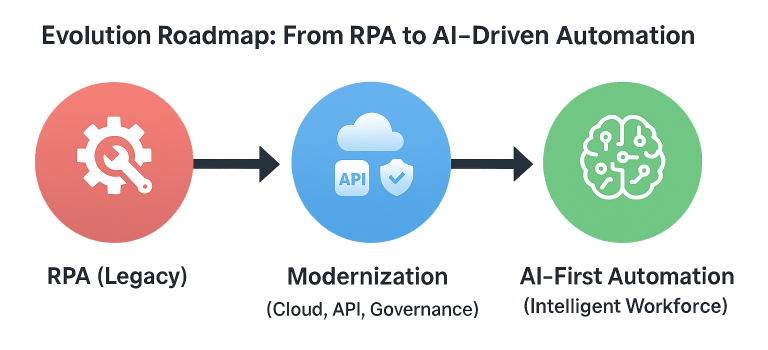
A big reason why RPA felt fragile was that it was often deployed on top of legacy, siloed systems. Modernization — migrating to cloud-native platforms, API-first architectures, and scalable identity and access management — changes that equation.
When organizations modernize their core systems:
- Automations can integrate through APIs instead of screen scraping.
- Data flows become cleaner and easier to govern.
- Security and compliance controls are embedded into the platform.
- New automations can be delivered faster and maintained with less effort.
Modernization lays the foundation for sustainable automation.
AI: The Front Runner of Automation
The real leap forward comes when AI joins the picture. With AI, automation moves from rule-following to decision-supporting and even decision-making:
- Document Understanding: AI can classify, extract, and validate unstructured content at scale.
- Natural Language: Automations can interact with employees and members through chat, voice, and digital assistants.
- Predictive Insights: AI helps anticipate risks (like delinquency) and surface opportunities (like cross-sell or retention strategies).
- Autonomous Orchestration: Intelligent agents can choose which process to trigger, how to handle exceptions, and when to escalate to humans.
With AI-first automation, organizations are no longer patching inefficiencies — they are re-architecting workflows for the digital era.
Governance Still Matters
It’s important to note that modernization and AI don’t eliminate governance concerns — they amplify the need for it. Automation must be delivered with:
- Clear ownership of each process.
- Segregation of duties for development, approval, and release.
- Auditability of every automated action.
- Least-privilege access for all bot and AI identities.
- Monitoring and observability to track both outcomes and risks.
Done right, governance isn’t a blocker — it’s what allows automation to scale safely.
From Legacy RPA to Modern Automation
Enterprises that once invested heavily in RPA are now asking: What’s next?
The answer is clear:
- Move beyond “bots that click.”
- Modernize systems to reduce fragility and improve scale.
- Put AI at the center so automation is intelligent, adaptive, and future-proof.
Automation should be seen not as a patch for inefficiencies, but as a strategic program that fuels transformation.
Final Word
RPA played its role as a bridge technology. But in today’s environment — where speed, security, and intelligence are essential — RPA by itself is legacy.
The organizations that will thrive are those that treat automation as a business program, modernization as the foundation, and AI as the multiplier. This is how automation moves from being a back-office tool to a front-seat driver of growth, compliance, and customer experience.